Cows and Shaking Christmas Trees

It’s that time of year when we reflect on our success and failures and make resolutions. There are the standard resolutions, of course, like health, wealth, and happiness, and if it is a fun New Year’s Eve, the resolution to never drink again. However, I never thought much about cows and shaking Christmas trees when making my resolutions. Until this year.

A two-year-old in my life has a Fisher Price toy called a See ‘n Say. The See ‘n Say varies in its themes, but they all have a dial that is turned to point to a picture. A lever is pulled to hear the sound connected to the selected picture. My toddler has the farm version. She is a bit worried and frightened of the cow. In fact she’s not much of a fan of cows in general. (A sentiment I share. See Spring in Oxford post). While it is easy to avoid the cow by skipping its picture and corresponding moo, there is a place to play the song, “Old MacDonald Had a Farm”, and no way to determine which animal will be featured in each verse. Playing the song, a fun activity, becomes a child’s version of Roulette, with her mother ready to halt the toy in mid-moo when the song stops on the cow. The cow is much like those unexpected things that come up in our lives, even after carefully planning the New Year ahead of us. We so want to hear the cat or the dog.  How do we get past the cow?

For most of us, cows continually show up and block our path, forcing us to evaluate our choice of direction and we either face the cow or run away. It all depends on the cow’s temperament. Sometimes, the cow is a lumbering, huge, innocuous distraction, noticed without altering our course. At other times, we might have to change our direction, take another path, because that ornery cow wants to trample us. The point is that cows are always in our lives, no matter how much we try to avoid them. Most times, we do not have someone who will deftly move us past the cow with a quick flip of a lever, so, as we make our New Year Resolutions, it is important to remember the many cows that will get in our way of achieving those lofty plans. We also need to recognize signs that our resolutions are attainable and personally fulfilling – not things we should become or ought to be doing – concepts I rely on way too much in my life. This is where the Christmas tree comes in.

The day after Christmas, I was sitting in my son’s apartment, waiting for him and my daughter-in-law to return from their Christmas getaway, and writing out my morning gratitude list, a daily practice I seldom skip. There was no wind, no air blowing from the heater, no refrigerator running, and no trolley rumbling by the building. Suddenly, and I mean without any visible or other cause, the Christmas tree began to shake, not a mere tremble of a branch or needles falling softly to the ground. That tree shook, violently, a harsh word, but accurate. It shook like it had a chill running up its trunk. The other freakish thing about that tree was that it was dry, but it would not let go of any of its needles. The bone dry tree never dropped a needle, even when we pulled on its branches.

Now there are several ways to explain the shaking. The thought of a rat running up the trunk of that tree was not an explanation I wanted to explore. Considering their apartment is shared with a hound/Labrador dog, I figure any critter in that place would have been treed long ago. Maybe the tree was tired of all the ornaments hanging on it, those symbols of the tree’s burden of providing cheer and goodwill. I had to consider the possibility of a post-Christmas tree uprising. An earthquake, perhaps, a slight tremble accentuated by the tree. But, unlike the Grinch, I think the most likely reason of all was not that my heart was three sizes too small, but that by taking the time to list my blessings, I was heard by the tree. There were no bells to ring on the tree, like in the movie, It’s A Wonderful Life, but I like to think several angels were getting their wings that day for guiding me, a hopeless, often clueless person, through another year and keeping me from encountering too many aggressive cows along my path.

And, let me tell you, that help is greatly appreciated and those wings were hard-earned!


(to be continued)


How to Spend Thanksgiving Alone

This year, Verizon, a cell phone service provider, is promoting phone-less holidays. Phones, like politics and religion, aren’t welcome additions to the dinner table. Thirty minutes to converse and gorge oneself isn’t too long to be phone-free. There was a time when I might have agreed with the no more phones for the holidays (after we’ve made it through the woods and over the river to Grandmother’s house). This year, I beg to differ, reserving my constitutional right to change an opinion. This year, I spent Thanksgiving alone.

Sounds pretty pathetic. To be upfront, it was a conscious decision to stay home after my last long road trip. I must confess, though, I woke up this Thanksgiving Day morning with the sole purpose of just making it through the day. Within the hour, my mood had changed from melancholy to happy, all because of my cell phone. Messages arrived from family and friends. Messages with a simple “Happy Thanksgiving” and my reply with a “Happy Thanksgiving to you!” connected me to the caring people in my life. I texted those I hadn’t heard from yet with that two word greeting. By mid-morning the day was filled with gratitude for my good fortune. It was time to bake a pie.

The next thing was to clean my apartment and get it ready for all of those family and friends who would join me for dinner. I showered, put the turkey in the oven, and although I set the table for one, you all joined me for that dinner, your presence reminding me of the blessings in my life and the abundance I often take for granted.

We didn’t talk about politics (well you didn’t; I had plenty to say) and religion remained at the spiritual level. Our conversation turned to the ways we are all connected. How fear makes us strike out at each other. How it is just as easy to smile at someone as frown. How there may be victors in war, but there are no winners, something I learned in my travels, gaining a greater understanding of our supposed enemies.* People, like us, trying to get on with life.

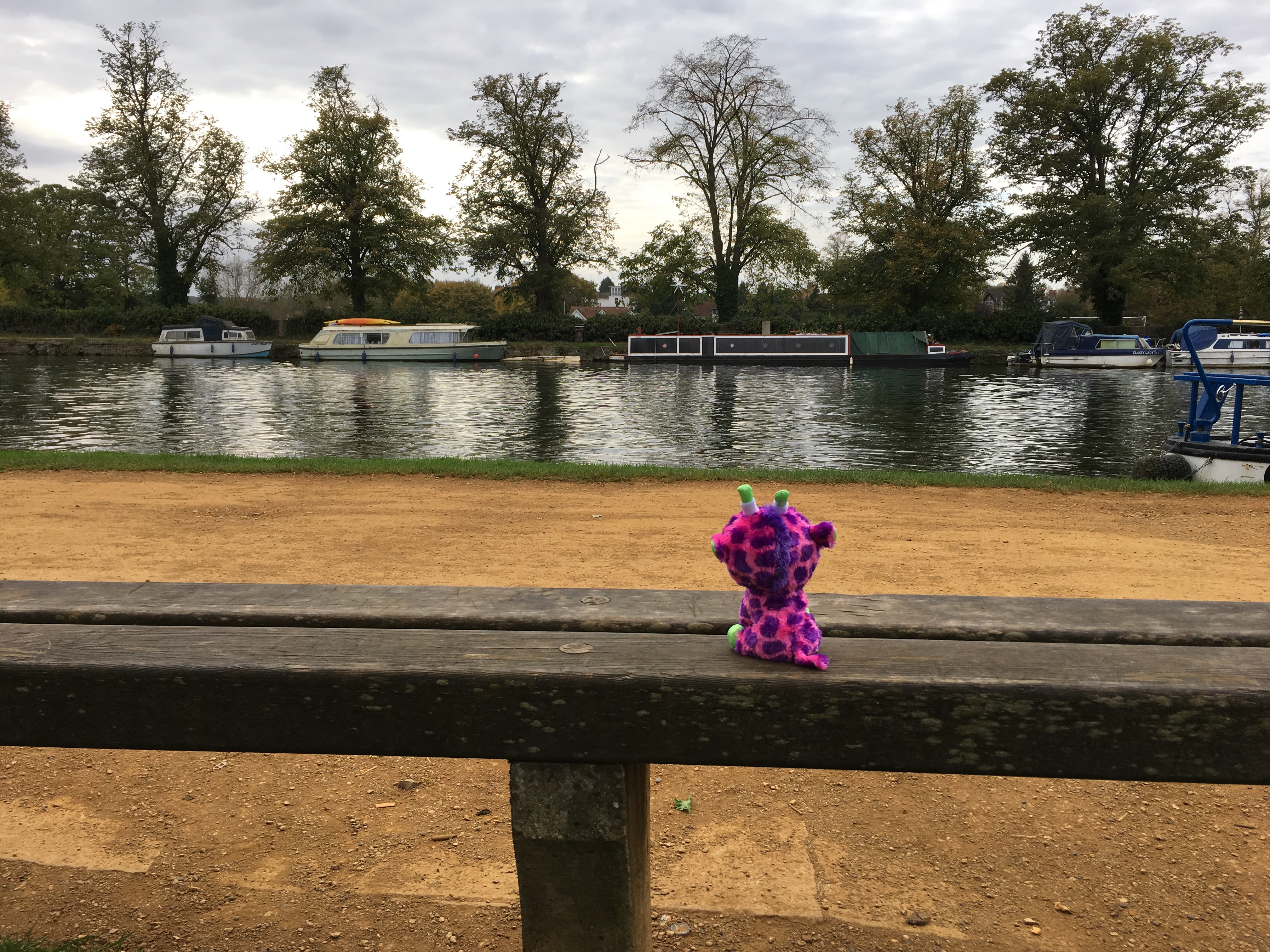
We (okay, I) took a walk along the river and listened to what the water had to say. (No cable TV.) After the water reminded me to bring a scarf next time, it also pointed out that while writing about gratitude and forgiveness at Thanksgiving is a bit cliché, there is a reason certain things are considered clichés and overused. There is a bit of truth in a cliché – it says or describes something in a universal way, and sometimes it really is the best phrase to use. The challenge is to carry that overused and often fleeting feeling of gratitude into our daily lives. How bad can overusing “Thank you” be?

There is a problem with inviting the idea of people to my table. It is hard to identify any annoying tendencies in my guests when I’m missing them. It means there has to be more reflection on the self — something I like to ignore. My tendency to hold grudges is a well-known fact (see reference to fourth grade in earlier post) and it is one of the shadows I struggle with and rarely overcome. Trying to deny this flaw is like trying to pretend I didn’t eat pie for breakfast this morning — the evidence is in the missing piece and my rumbling gut. Maybe I can deal with this one character flaw by making sure that those persons I hold responsible for my injustices are actually guilty. (By the way, I have the evidence, and you know who you are, that you did indeed take a picture with my Brownie camera.)

Maybe we shouldn’t hold entire countries, religions, political parties, cultures, or particular high school groups accountable for our own fears and our own insecurities. Many of my posts talk about the world wars from the allied perspective, because I am American and was traveling in the UK in the centenary year of WWI, but ordinary people all over the world suffered and continue to suffer because of violence or wars fought over political or religious beliefs they do not share with their leaders. Maybe we (I) should try to be more tolerant of the people around us.

So next Thanksgiving, when we are ready to throw the turkey at Uncle Burt or tie up an over-sugared child, let’s excuse ourselves, find our phones, and text everyone a

                                           Happy Thanksgiving!


*The full quote attributed to Neville Chamberlain: “In war, whichever side may call itself the victor, there are no winners, but all are losers.”

My Lost Horizon

Labor Day weekend has come and gone. The summer has unofficially ended and I look forward to the rain. Boy, oh boy, do I hope for rain. I’m one of those people who dislike summer. Summer is a distrustful companion, an overly optimistic friend who seems transparent, but who promises the ultimate snake oil, that illusion of “fun in the sun”.

Astoria depends on summer tourism, beginning with the Crab-fest in April, then moving on to the Goonies anniversary, the Music Festival, the Scandinavian Festival, the Fourth of July, the Clatsop County Fair, and the Astoria Regatta. August brings fisherman and sea lions back for Chinook salmon. Highway 30 and Highway 101 congestion turns a normal 10 minute drive across the bridge to Warrenton into an hour. All of this is necessary for the local economy. After all, I am a new resident here, anxious for my share of the Columbia River experience. It is very rude to claim a place as my own and then wish to keep everyone else out, hoarding the experience like people who build homes on lakes and then try to limit others from moving in and ruining their Shangri-La. And as we learned in Lost Horizon, an unaltered and unencumbered life is really not very fulfilling.

And that is what summer is – the year’s Shangri-La, offering up perpetual holidaying, loving family barbecues and family reunions, patriotic experiences, and the promise of daily sunshine in our lives. Because expectations for summer are so grandiose, its disappointments sneak up on us, blurred by the sun in our eyes and dulled by colorful stands and sidewalk displays, shelves filled with swirling pinwheels and bright orange and yellow and watermelon-colored beach necessities. If we do not fit into this summer picture, we feel guilty – shamed into participating in the festivities when all we want to do is sit on the couch and close the blinds.

Winter, with its shadows and fog, lets us know there are frightful things hidden away and ready to jump at us in an unsuspecting moment. Winter makes us aware. It is transparent. We know there is danger in the fog or in the tempest of the sea. Winter tells us it is okay to hide away from its dangers. And if we venture outside, it slaps us with the reality of a freezing wind or it knocks us off our feet as we navigate a sidewalk. Winter is real. It is no Shangri-La. It says “my sunshine is a ruse”, because if we step out of a winter sun into the shadows, we end up on our arses.

Astoria is a bit like the seasons. Summer hides the reality of lives here, scrappy and resourceful people making the most of the summer economy, who know that once the rain hits, the rest of the year’s living will depend on those ticket sales from summer. Yet there was a collective sigh from the permanent residents here in Astoria when the first breeze of fall returned, reminding people to button that sweater or think about where they left last year’s rain slicker.

Last week, I awoke to the sounds of sea lions and the smell of rain. I packed my beach bag and headed to Cannon Beach. Maybe there is a Shangri-La and maybe it is raining there.

Pleasantville

Sometimes I feel that I moved to Mr. Rogers’  neighborhood.

My improved status as a local (anointed after I’d been seen walking along the river every day for a week or two) is rewarded with a nod or smile as I pass other locals on the path. The trolley, full of tourists, ambles along its tracks and the driver gives a jolly wave as it passes. As the sun sparkles off the river, colors fill the foggy, grey landscape and heads poke out from under raincoats to catch a few rays. There’s the man who literally lives in a rolling doghouse with his cat. Artists get out their paints. Photographers risk taking out their cameras. Of course, there’s the seedier side of life on the river. I’m reminded of it when I pass the group of trees and bushes that hide the drug deals or the homeless camped along the embankment.

A friend of mine said I moved to the Northwest corner of Oregon because I want to live in England. Considering this area’s reputation for being the rainiest place in the U.S., I suppose she might have a point. The weather here was one of the deciding factors for me. Many people consider weather when choosing a new place, but I’m in that minority who prefer cold, rainy climates. Yesterday, the temperature reached 72 degrees. I heard one of my co-workers exclaim “it is so freakin’ hot out there!”

Astoria’s economy is dependent on tourism as people come through on their way to the beaches, to visit the Goonies house, or to follow Lewis and Clark’s great adventure. But there’s more to Astoria than tourists. It is a port city, apparent every day with a walk down the riverfront. The Columbia River Bar (where the river meets the Pacific Ocean) has been known as “the graveyard of the Pacific”. Wikipedia reports 2000 ships have sunk since 1792. It only takes one visit to the maritime museum to understand how dangerous it is for shipping at the mouth of the Columbia and the need for river pilots who take the ships through the jetties. The Coast Guard is here with its Cape Disappointment station on the Washington side. Fort Rilea, the Oregon National Guard Military Training Center, is just down Highway 101 in Warrenton.

My favorite beach is a mere 25 miles away. My summer is planned. Explore Fort Stevens. Visit Fort Clatsop and learn about Lewis and Clark. Climb the Astoria Column. Visit the Oregon Film Museum. Watch the Goonies movie before the big 30 year anniversary gala. Drive the coast of Oregon. Drive over the iconic bridge and visit Washington (viewed daily across the Columbia). Attend one of the many festivals, including the Astoria Music Festival.

California sea lions arrived in large numbers about five years ago. The port is struggling to find a solution to the thousands of sea lions feeding here and costing the port around $100,000 in damages to the docks every year. They swim up and down the river, popping their heads out along the way and making it difficult to separate their cuteness from their obvious bully mentality manifested as they compete for space on the docks.

The season’s first cruise ship will arrive this week. And while we’re on the subject of tourists and cruise ships, may I ask a favor of you? When you are in line to get your coffee, please be kind to your barista. She may be a newbie and might ask several times to clarify your drink. She is learning a new register. She is learning the preferred way to mark your cup. And, possibly, she might have served around a gazillion customers in the last three hours without a break. And very possibly, the previous customer yelled at her because the new barista did not intuit that the customer did not want what he ordered. She is doing her very best. It’s just coffee. Be patient. If your drink is wrong, she’ll fix it.

She’ll get the hang of it pretty soon. (Or as someone wise once said, “One can only hope.J”


Watch for my new website, coming in the next few months, which will provide more informative and traditional travel descriptions and tips.


Musings on a Shallow Life

The U-Haul truck banged against the wall of the storage unit building as I backed up to maneuver it into its parking space. This was the third time I had backed into that wall. Was this a metaphor for the need I had to bang my own head, repeatedly, against the symbolic door I was closing behind me? Perhaps the wrong turn in a one-way drive represented a wrong turn in my life. The truck’s empty bed represented all that was lost or given away and reminded me of all the things dropped in my brother’s garage awaiting their fate – donate, take, or toss in the go-to-the dump pile. That U-Haul represented the pain of moving on.

The original intent of this post was to discuss the anguish of tossing out a life I wanted to keep and how difficult it is to create a new life and how discarding things from the past, though necessary, isn’t cathartic. But yesterday I opened a box I had deemed important enough to pack into my car. It contained manuscripts. My manuscripts.

I pulled out a 300+ page novel I’d put aside to gain some distance from it before tackling the editing process. Next were the first five chapters of a children’s novel based on my child’s fear of the shower. There were folders with children’s short stories, the adult stories written for my creative writing class, notes from my writing group on my novel, and a 100 page novella written for the Three Day Writing contest – a marathon writing session over a Labor Day weekend. This box contained my life’s passion. It held the remnants of the happiest years of my life, but also the most frustrating years of my life.

Stuck in a house in the suburbs, surrounded by a political and religious culture to which I couldn’t relate, my life revolved around carpools, volunteering in my children’s classrooms, baseball games and ballet classes, part-time jobs, and all the necessary chores of keeping a household running and a family nourished. I spent mind-numbing and bum-numbing hours (some weeks up to 20 hours) in a van transporting children from school to home or to friend’s houses or to after-school activities. They did not attend school in the neighborhood, so sometimes these trips could take us miles away from home to meet a classmate for a school project. Mostly I was happy doing all of this. It was a necessary, yet fulfilling existence. There is much to be said on being a family’s anchor. I knew I made a difference. And every time I am with my children, I know this was not time wasted. But something was missing and I filled that void with my passion for writing.

It might have been Faulkner who said, “If your resistance to writing is greater than your desire to write, then just give up…you are not a writer.” I never had that resistance. I’ve written since I could actually write. As a child I wrote stories, beyond my scope or comprehension, of adventures featuring myself as the seemingly boring, ordinary girl who transformed herself into a heroine. Creative writing classes were mixed in with my college business and computer classes. While working as a computer programmer, I often used my lunch hour to write. One year I collaborated on a musical revue script with fellow insurance nerds who came together to sing and play in the company band and chorus. And through all those years of carpooling, I wrote. I also collected a box full of rejection slips. So maybe I don’t have a natural talent. I did have the passion to write about my nondescript and, what many would consider, colorless life. It was that life that fueled my passion.

So what happened? What makes us give up on our dreams? In my own case, I decided to better myself. I decided to prove myself to the world and to give myself some credentials. Apparently a business degree, that I wasn’t using, was not enough proof that I had merit. I went back to school and pursued a second BA in History, telling myself that this would help me in my historical writing. It wasn’t a mistake, really, because I loved school and of course, writing term papers and exams never intimidated me. I found, though, that I needed to get A’s to prove my worth to the world. Five semesters of French, two of which resulted in a B+, destroyed that goal. It was ironic, though, that my best creative writing happened when I had to write stories in French. (It’s too bad my poor grasp of French got in the way of a good story.)

Going back to college opened up a whole new set of insecurities for me. My rejections must have meant that I was not a serious writer. That’s when I made the fatal mistake of taking myself too seriously and going on for an MA. Again. Must get A’s. Must prove myself. Here’s the thing: I do not like academic writing. I do not like trying to find an obscure topic and making it important enough to forward a career. It hit me one night, as I slogged through yet another revision of my thesis on French labor theory, that my strengths, my talents, my passions, are not in proving my great depth, but in writing about ordinary things and perhaps, making fun of myself. I’m better off when I don’t try to be serious. Passion happens when we stop trying to impress others. Passion happens when we are true to ourselves and understand that writing comes from within, even if there’s not much in there. My monetary worth as a writer is roughly $250, but the emotional high I get as a hack is much, much greater.

This journey to my truth cost me a lot personally and financially. All my school notes and A exams? I chucked those folders into the go-to-the-dump pile. But the box of rejected and sub-standard manuscripts? I carried them to my new home and when I opened the box, I smiled and remembered the hours of bliss I enjoyed writing such crap.

I have two new boxes set aside. One is for my latest work-in-progress and one is for the many rejection slips I will encounter along the way. I’ve rediscovered my passion and I’m working toward that contentment I had so many years ago. If good writing and enduring stories must be filled with tragedy and unhappy endings, then I suppose I’ll never make it as a serious writer. Getting back to reality doesn’t always mean facing the bad things in life. Reality is the present moment and while sometimes it is not pleasant, there are realities that are happy and fun. Writing should reflect the tragedy of a life not lived to its fullest, but also a life filled with the inconsequential smatterings of fluff. I guess that the fluff will be my contribution to the world of literature.

Reflections on Libraries and Loos

Today I checked out my first book on my new library card from a tiny library that serves its main clientele with a section of Large Print books that spans an entire wall. There is a computer search available, as well as a computer check-out, but the library clerk stamped the old-fashioned card under the front cover with my book’s due date. I’m the first person to borrow this particular Christopher Morley title since 2008. Before that it was marked four times from July 2005 to November 2005.

Local libraries, after the visitor bureaus, were my first stops in the United Kingdom. Sometimes the uniqueness of a library reflects the character of a place. For instance, the library in Weymouth hosted the obnoxious racket of sea gulls and pigeons on its skylight. Not unexpected with the English Channel a street away from the library. The staff, though, welcomed visitors with a hometown attitude, ready to help with Internet access or information on Weymouth. And the WWI exhibit, standard among libraries eager to promote the war’s centenary, was put together by genealogists with cut and paste displays using unprotected and unpreserved primary source materials. Poster board displays featured original newspaper clippings pulled from scrapbooks and pasted to the cardboard.


Much of my time in Oxford was spent in the local history section of the Oxford Central Library, located in the heart of the main shopping district, next to an inside shopping mall. I didn’t have any academic credentials to get into the Bodleian. No problem, because I did get to tour the Bodleian and see a WWI exhibit there. The main Oxford public library kept me busy enough with stories of riots, murders, and ghosts. (It made for some fearful evening walks back to Summertown). Most people I met in the library were locals, or students from the local schools or from Brookes (the other university). I suspect the mall was the reason that even in a downpour, the library was a last resort. The computer stations, always in demand, caused many altercations between retirees and interlopers looking for internet access. I made it a point not to carry my computer into Oxford, so I do not know anything about the wi-fi there. It was all about the books for me.

The Cambridge public library, however, seemed (and I say this not to make blanket generalizations) a hoity-toity place with no regard to the needs of a visitor. To be fair, it is housed inside the big covered shopping mall, a place transformed during a rainstorm from a mall, somewhat neglected by shoppers, to a terrarium, air thick with humidity, and a floor made treacherous by dripping umbrellas and wet feet. All I needed was to print out my boarding pass for the Eurostar train from London to Paris. I had a tight connection with a change in train stations in London. No problem in Norwich. No problem in Weymouth. But Cambridge? The woman insisted I must get a library card before I could use the internet. No exceptions. No help for a visitor. I asked if there was someone who might get on and print it for me and I was basically told to shove off. It is possible that I’d have encountered the same lack of hospitality in Oxford on a July day with half the world visiting. After all, I left Oxford in May right before the serious tour buses entered the city. (This being fair stuff – it’s to show how sensitive and open-minded I am. Oxford is the clear winner.)

The Norwich Public Library is home to the Second Air Division Memorial Library. It was there I found my father’s picture with his flight crew and information about his WWII airbase, Halesworth. I’d seen this book and photo before in the Library of Congress, but somehow it meant more to look at it in Norwich, where he’d visited as a nineteen-year-old airman and again as an eighty-year-old veteran. The staff there loved Americans and some told me of their own experience with the Americans or repeated stories told to them by parents and grandparents. I found Norwich to be especially open and friendly to Americans and I guess it has to do with the war. The librarians in the main library helped me through some printer and internet problems with great smiles, helpful hints, and always premised with “Don’t worry, we’ll get it sorted.” Outside the library was a display honoring the Norwich residents who lost their lives during WWI. Nothing fancy, but along with the displays, they offered help for those looking for records of WWI or WWII soldiers for family histories.

Besides the WWI exhibits and the focus on local history, there is one thing these libraries had in common. None of them had a public loo. In the U.S., we get accustomed to knowing there will be a pretty decent bathroom we can use without having to leave the library. I learned that finding public bathrooms was the most important part of my first day anywhere in the UK, Italy, and France. Once I figured out I was on the right train, my next task was to determine which way I’d have to go for the lavatory. As soon as I was off the train, I located the bathroom in the station, because most times, I’d be back in that station for my departure. Once I was settled in my room, I always searched for the tourist information center and bought a map where I circled all the restrooms within a 2 mile radius of the main town center. I took my mother’s parting advice that when traveling “always use a bathroom when one is available.”

In the UK, I located the local Debenhems or Marks and Spencer department stores. They had well-cleaned and well-stocked facilities. Both of those stores also became a go-to place for food, if I wasn’t feeling adventurous. The downside to this strategy is that now half my current wardrobe was purchased in Debenhems or Marks and Spencer. The Covered Market in Oxford had a very convenient restroom, if there wasn’t a tour bus full of women waiting in line for the four stalls, one of which was usually out of order. One time I managed to use the staff’s bathroom in the Oxford library, because I asked a new employee who didn’t know I wasn’t allowed to have a key to the loo. One thing I learned in England is that the women’s bathrooms are often attended to by men. So just saying, you might want to watch how you come out of the stall.

That brings up another point about foreign bathrooms, whether in Europe or here. It is important to understand the mechanisms of the plumbing, but also the door. Sometimes a locked door isn’t really locked. So, just as an example here, you might find yourself in a Star Trek-like pod on a crowded train, thinking the door is locked, only literally to be caught with your pants down by five or so other passengers, the first being a man who pressed the blinking OPEN button.

In Italy, I learned the easiest way to get to a bathroom is to plunk down a Euro for an espresso and there is immediate access to the café’s W.C. It usually costs more to sit at a table in a café there. Since my only interest was a toilet seat, I drank my espresso at the bar. It’s a bit of a catch-22, because the more espresso I consumed, the more often I needed to buy one.

I don’t even want to think about the Paris situation. Pay any museum entrance fee or find an accommodating Starbucks. It’s your best chance. And only use the bathrooms in the park near Notre Dame if you are desperate.

I’m happy to report that my local library has a restroom available. It’s best to be prepared…

A Thousand Sea Lions and One Missing Can Opener

There is a problem with relying on the Last In First Out process to select the first KITCHEN boxes from my storage unit for my move to Oregon. I assumed that the boxes in front contained the essentials needed for a rudimentary beginning in my new apartment. So I ended up with a pasta wheel and no table knives. I have a shortbread mold, but no mixing bowls. And when my son and his girlfriend came to visit and wanted to make dinner, we realized there was no can opener in the three drawers filled with kitchen utensils. A minor problem, for sure, solved with a beer can opener, but I wanted my can opener. Opening those boxes was like peering into a time capsule. What did that previous person think was important for her future?

There are many factors in deciding where to live when the world opens up without issues like a job offer or a spouse. In theory, this seems like an ideal situation. Yet, having too many choices and a mind content to weigh every possibility marred my thinking. My list of where I would not live grew and my list of preferred places changed daily. I realized that two things hampered my decision. First, I had to allow myself to make a mistake. If it doesn’t work here, I’ll move on. The second, and most stalling problem, was the storage unit in Utah. How I would move my possessions stymied my decision. It is expensive to move furniture and it is expensive and silly to keep up a storage unit. It is time to Feng Shui my life, because my stuff is in the way. There aren’t many things I want from my old life. Much of it makes me sad and keeps me from beginning again. Anything of emotional value to me will fit in my car. Living out of a suitcase for a year prepared me for this moment of downsizing. The year of traveling also prepared me for making the intuitive decision to settle on the coast with the Columbia River in my backyard and the ocean beaches just down the road on Highway 101.

My backyard is where the California sea lions come to do whatever sea lions do for a few months of the year. Hundreds of them. Sometimes around 1600 plus. Their barking is constant and much louder than the highway noise near my apartment building. Every night I go to sleep to the roar of sea lions and I love it. I guess it’s my version of katydids or crickets on a summer night. Sea lions are new to me. Anything maritime, from the Coast Guard base nearby to the weird array of beards I encounter daily, is exotic and as foreign to me as anywhere I visited in Europe. The cable guy told me he used to be a rougher. What exactly is a rougher? I now live in an earthquake zone, but also a known tsunami area. Salt Lake City, Utah has an annual rainfall of 13 inches a year. Rain comes down in feet here. Sometimes it can rain for a month straight. This is Lewis and Clark territory. It will take years for me to learn the history of the area. I don’t have to calculate sales tax anymore. I’m going to have to exchange my snow boots for rain boots and my winter coat for a good rain slicker. Luckily sweaters have always been a summer staple for me, so no problems there!

Every walk I take introduces me to something worth studying. But how long before it becomes mundane? Will I cease shopping local and head for Portland every week to visit Whole Foods or Powell’s Books? At what point will I begin to complain about the ten thousand summer tourists and the congestion on the highways? How long will it take for me to wake up one morning and say, “I wish those (fill in expletive here) sea lions would shut up!”?

How long before I look at my new can opener and decide it is too worn or useless to keep anymore?


Home Sweet Home

This morning I awoke with a cat on my face. Her fish breath gagged me and overpowered the fresh morning air. Her amber eyes focused on my hair, before she leaned in to chew my bangs. For some reason this cat loves humans, greeting us at the door with as much excitement as a cat can convey – in other words, a miniscule bit of attention. It’s a ruse. She loves us for our hair. It is a mystery why this cat isn’t riddled with gigantic, throat-consuming hairballs. Regardless of her hair-fetish, the cat represents the problems of returning to one’s past. I’ll explain as soon as I quit sneezing.

My childhood is marked by a succession of cats. First there was Toughy, my brother’s Christmas present. Toughy was grey and white-striped and lived up to his name. Un-neutered and always ready for a fight, he lived for a very long time where his longevity was marked by a missing tooth or claw, holes in his ears, and bare patches from his amorous pursuits. Next came Taffy, a lovely cat with no fear and great acrobatic qualities. Her most stupendous feat of daring involved her insistence that she could catch huge geese. We often saw her orange body flying above the grass in the neighboring field as she defied gravity while clamped onto the foot of an airborne goose. But Tyler understood about coming back home. He was a stray (as most of them were). After a couple of years, he ran away from home. Every Thanksgiving, Tyler showed up at the door, walked in like he’d never left and kicked the current permanent resident off its place on the couch. Tyler stayed through the middle of January and then he disappeared until the next year.

IMG_1407

It is true that you can’t go home again. Main Street looks the same, minus the train station. My mother’s house has a few improvements, yet it hasn’t altered all that much in 40 years. Even though my father and older brother are dead and my mother is older, there is much here that hasn’t changed. Emotions I’d forgotten about come back in the form of vague feelings of uneasiness. I remember this house as a refuge from the insecurities of my Junior High and High School years. In some ways the only thing that has changed is the cat. Yet, the new cat means everything in this experience. The cat isn’t the same and neither am I.

Perceptions of our childhood guide our reactions to coming home. We all know the high school jock or cheerleader who continues to rule the halls of their high school into adulthood. I am always flummoxed by those people in my life who speak about their childhood, especially their High School and University experiences, as something extraordinary. They search for old classmates on Facebook and connect with people they didn’t think of for decades, falling back into childhood friendships. It seems so odd that out of a lifetime of 60 years, others choose to believe the three or four years of high school (or Junior High or college) were the best years of their lives. Those years marked the most isolating times of my life – more opportunities to not fit into the social groups. I don’t ever want to go back to High School.

There are many advantages to a small town, but a person can be marked or labeled from the first grade on. It isn’t easy to escape your fate, especially if you are shy and a bit naïve about life. Having four brothers and a cop for a father didn’t help much either. I was one of those girls that circled the edge of all the groups. Always invited to parties, I was accepted without being popular. I sang in the choir, played my flute in the band, and even served as the editor of the high school paper. But I don’t remember those years fondly.

HOWEVER easy it is to belittle the high school heroes that haven’t moved on, I am faced with another question. What if my memories of my own angst-filled existence are similar to the former kings and queens’ delusions of grandeur? I’m finding out that maybe the story I’ve written about my own life as an outcast is perhaps just as distorted as the stories told by others who saw their young lives as glittering. I have the advantage here. I’m the new girl in town. People can guess my identity because they know I’m back; they remember me because I answer my mother’s door. Yet I feel guilty for not remembering these people from my past. The most disturbing part is that, just like the cheerleaders, I’m judging people from their actions as children. I met someone just today, a man who I’m sure never knew I existed through most of our school years together. I would never have guessed the man outside the door was that same boy. He was personable and accommodating and complimentary. When I told my mother that an incident in fourth grade was the way I always remembered this man, she told me he would be mortified to know that is his legacy in my mind.

I’m mortified I cannot remember my classmates. I am ashamed I have chosen to lock them in the prison of adolescence and deny them parole, even as they grew into parents and grandparents and experienced both joy and tragedy in their lives. I’m ashamed that I never knew I was considered one of the older unapproachable girls that boys in the class behind me wanted to date. My determination to be an outcast makes me realize I was just as guilty as my seemingly successful peers. I’ve focused so much of my adulthood on proving that I’m better than those I perceived as looking past me.

This place isn’t for me. Even with my awakenings in the forms of a new cat and the end of my long-held perceptions of my childhood, I know I must move on. My life isn’t in the past. But that doesn’t mean I can’t invite people from my past back into my life. The key is to accept or reject them as they are now. Everyone is a product of their experiences and their capacity to learn from errors in judgment. If they are willing to forgive, I can return the favor.

But the cat stays here.

Looking for the Blue Flowers

My friends watched me as they listened for the train we had rushed to catch. My uncertainty about my future hit me as I stood facing an already open turnstile in the BART station, wondering if I needed to put my ticket in before walking through it. (The answer is yes, of course, otherwise it messes the ticket up for the exit). At that moment, I was incapable of making any more decisions. Clearly, my friends wondered how I managed to travel through Europe for six months if I could not master BART.

Decisiveness has never been a strength in my personality. In Europe, though, I encountered very little hesitation in my actions. I made quick decisions as I ran for trains when their destinations were unclear. I picked restaurants without analyzing the menus to exhaustion. I took chances and allowed myself to get lost. And most times, even bad decisions worked themselves out to be good decisions. There are two reasons for the purposeful life I led in England. First, I had no travel companion with whom to banter about choices. The second reason had to do with a dream about sparkly, blue flowers on rectangle trees.

Dreams are a useful way for me to work out problems, though I am a bit worried about the dream where I was literally cleaning out Nixon’s kitchen cabinet. I can reproduce detailed descriptions of dreams I had in childhood, like one that involved a whole War of the Worlds scenario and another where I saw Lincoln’s face in my bedroom window. (The penchant for American Presidents is a bit disturbing.) As the trip came together and as I closed up my apartment and quit my job, I began to wonder about doing something so out of character that even many family members and friends did not think I would actually go through with it. I suspect I thought at some level that I would change my mind. About a month before I left, I sorted it out with a dream.

In the dream I was trying to get to a familiar place, but the path was blocked by an immense black hole. There were bushes overgrowing the path around the hole, making it very dangerous to navigate the hole and get to my destination. I decided to change my route, knowing that I would find my way around the abyss and be back in a comfortable place again. Only I did not know where the detour would take me. I followed my bliss by taking Robert Frost’s less-traveled road. That is where I found the rectangle trees dropping blue flowers onto the road. People stopped on the sidewalk and danced in the flowers with me. I watched as the petals fell on me like glitter off a Christmas card. When I woke from the dream, I had no doubts. Thank goodness for that dream. It helped me understand that not all obstacles are permanent impediments. It is possible to get to a desired place in life, even when a black hole blocks the way.

I’m in Nevada now, stopped on my way back to Idaho from another stay in California. I am so lucky to have my loved ones back in my life. I have many people to care for, but there are also many people that want to bring me into their lives, to include me in their homes and activities, and to introduce me to ready-made friends. It is a privilege to be needed – to make a difference in the lives of others. Before I took my amazing journey, I planned to decide on my life’s next destination before I came home. It hasn’t quite worked out as I planned. There are delays in making that decision, as well as less certainty about how I will get to my dream place. I must decide not to decide. Maybe the original detour in my life’s journey was necessary, making it possible for me to be in this place at this time. I wrote about looking for yellow butterflies and searching for pink shirts. Now, I need to trust that I will experience the blue flowers and rectangular trees on my life’s updated route.

Thank you, all my friends and readers, for following my blog and posting comments. Even though I decided to keep the later comments private, I did read them and I appreciate the support you gave me. Your support reinforced my belief that my life is truly blessed. I will continue with my blog, but my focus will change, now that I’m back in the USA. I hope you will continue to read and make comments. And I wish that you all will get to see the blue flowers of your dreams.


Back in the Good Ol’ USA

The moment I stepped off the British Airways plane and walked into the San Francisco terminal was the moment I severed my last connection to the United Kingdom. It was a bitter-sweet moment. I loved the UK. Returning home was self-imposed, because I missed my family and friends. Also, my return home involved the UK’s hospitality – it welcomed me for six months, no more. It is remarkable how much I noticed about my home country, once I re-established my American life.

The best thing, of course, was reuniting with my children. The second-best thing? Drip coffee. This is not a complaint about the café press. I adore coffee from a press, but I do not adore cleaning it. And I’m right in there with the espresso crowd. Yet it’s easy to understand why instant coffee is a hit in the UK. It’s a quick dose of caffeine in the morning. The wonderful thing about drip coffee is that I can make a pot and leave it to simmer into a tar-like substance for much of the day. It sounds terrible, but I learned to drink strong, sludgy coffee when I visited sheepherders with my Deputy Sheriff dad. Sludge tastes like home.

I cannot seem to get enough American Mexican food. Tacos, burritos, enchiladas, and refried beans did not taste the same in England. Or pancakes or turkey…

One unexpected pleasure is the view of the San Francisco bay from my daughter’s home. Watching the fog roll in at night as it extinguishes city lights is better than any television. When the fog rolls back in the morning, so much is revealed, from the deer standing near the front window to the two bridges that define the bay – the grand white girders of the new Bay Bridge and the familiar reddish-orange of the Golden Gate Bridge. On a clear morning, the sun reflects off the water of the bay and the skyscrapers emerge from the haze.

I found it a bit difficult to get financing for a new car when I have no real home and I was out of the country for six months. Really! Do I look like a flight risk? Excellent credit and a helpful car salesman soon solved the problem. I am now a proud member of the American driving public. I also put 1000 miles on my new odometer, within one week of purchasing my car, with a drive across Nevada to Idaho. Trust me. I’m not on the run. The State of California and my bank can find me in that little Hole in the Wall.

The drive reminded me of the country I left behind and how, in one 10-hour day, I can drive through the Sierras with their massive pines and icy blue mountain lakes, only to descend into the flat, lonely desert of Nevada. Some observations from my drive:

  • Is it better to stop at the only rest stop in a couple of hundred miles, when it is located off the road a mile into the trees and risk either Sasquatch or the Unabomber or is it better to hold it and risk some horrible urinary consequence?
  • Rattlesnakes at rest stops. No explanation needed.
  • Sometimes the most interesting thing was when I met up with a car whose cruise control was set just a tiny bit lower than mine and it took half an hour to pass it. Who flinches first and alters the cruise control speed to stop the standoff?
  • Reading the owner manual of a new car while driving 80 miles per hour is never a good idea.
  • I’m not a fan of the desert, but there is a subtle beauty in the desert in the fall. I noticed the colors looked like layers of decorative sand placed in a jar. First the layer of black asphalt that blended into the red fire bush alongside the road. The fire bush melded into the blooming yellow-topped, dusty-green sagebrush. Beyond the black, red, yellow, and green swirled intricate shades of beige sand, scattered with dots of black pines. Now if there could just be the white concrete of a rest stop in the tableau…
  • No matter how many radio stations across Nevada are dedicated to Country Western, I still don’t like it.
  • The boredom of the drive is somewhat alleviated by allotting two Pretzel M&M pieces for every five miles driven.

I arrived in Wendover (a town divided between non-gambling Utah and gambling Nevada) about dusk. An unusual amount of rain had fallen earlier in the week, covering the normal, compacted, snow-colored salt flats with standing water and with the lowering sun, it looked like a gigantic blue-water oasis in the middle of the desert. In all my years in Utah I’ve missed that view of the Salt Flats. However, the monotony of the drive hasn’t changed and I rejoiced when the unmistakable stink of decaying brine shrimp preceded my arrival at the Great Salt Lake.

I’m in the mountains of Idaho right now. I’ve returned to my small hometown for a bit. There are pickup trucks with gun racks in their cabs and antlers in their beds. The diner is filled with cowboy hats and boots and deer hunters in camouflage. Most people live within an easy walking distance of the main street and grocery, but everyone drives. I remember that hiking from sea level is a lot easier than from beginning at a mile high. Freight trains roll through the town every night and their whistles comfort me just as they did in my childhood. And last week, I experienced thunder snow for the first time in a while.

I remember why I couldn’t stay here and I’m anxious to begin my life again, but in many ways I’ve come full circle. The spires of Oxford seem so distant from my life now. I’m seventeen again – bursting to escape. As George Bailey said in It’s A Wonderful Life, “I’m shakin’ the dust of this crummy little town off my feet and I’m gonna see the world.”

I’ve seen some more of the world and once again, my life is ahead of me.

But it’s nice to be back home in the USA.