Category Archives: Uncategorized

Salsa at the Old Fire Station

One thing on my bucket list is to take salsa dance lessons. And the reason has to do with my inability to let loose and let go and well…not be me. This image of myself as being more English than the English was pretty much reinforced when I took the opportunity to take my first lesson. It’s like when I learned to tap. I tried so hard to express myself on stage. I exaggerated every arm movement. I forced myself to emote. And when I looked at the video of those performances, I realized I am just a stiff-armed, stiff-legged, smiling stick figure! The important things, though, are that I tried salsa and that I learned something about promoting art in the community and tackling homelessness in the process.

Oxford is a fantastic place for experiencing any of the arts. Any day of the week it is easy to find some exhibit, performance, reading, or movie to attend. Last week Brasenose College hosted its annual art week. Plays at the Oxford Playhouse range from propaganda aimed at saving the NHS to the 17th century ‘Tis Pity She’s a Whore. There are readings at Blackwell’s Bookshop. Any type of music performance is available daily. Visual art is widely represented. So, it makes sense that community arts have a place to flourish and that creativity isn’t just available to those with homes and stable mental health.

The city has quite a vibrant street performance culture. I have yet to see a human statue, although there is a bunny who spins on a bike filling Cornmarket with bubbles. The regulars include a fire juggler, a contortionist, and several musicians. One morning I watched a fiddler on a tightrope. On another afternoon a tyrannosaurus terrorized the crowd. The rules for buskers are strict and numerous. They must have a license to perform. They cannot stay in one place for more than an hour and there are designated places where street performers are allowed to set up. There are noise restrictions (no bagpipes, for instance) and they cannot ask for donations.

But it is impossible to navigate many of the main streets without being approached by someone asking for money. It doesn’t appear that there is much done to move these people along, because I pass the same people in the same places every day. There is a man who claims the sidewalk in front of Marks & Spencer. He is a fixture on a blanket accompanied by his dog. He might be selling the Big Issue, but most times he seems to just hang out. It is easy to give money to a performer, yet difficult when someone claims to be hungry or homeless. Is it a scam or are they truly in need? The city launched the Your Kindness Could Kill campaign, encouraging locals to give money to organizations rather than beggars, noting that it contributes to the problem of homelessness and it discourages those with addiction and mental health problems to get the help they need. It is hard to keep tourists and visitors or even students from giving money. Oxford participates in another initiative, No Second Night Out, which aims to find accommodations for rough sleepers.

Oxford, like other cities, does have a very visible homeless population. The statistics for homelessness are a bit complicated with classifications of rough sleepers, non-statutory homeless, and statutory (those people the authorities are required to help find housing for). Sometimes it is hard to tell who is actually homeless when you are in a very popular tourist destination, but they gather near St. Giles churchyard or around the monument to the martyrs as darkness falls. There’s a group of men with their dogs that hang out regularly near the Thames in Christ Church Meadow. There is a larger concern for sixteen and seventeen year old teens who have been kicked out of their family homes. This is the population the charities and city hope to get off the streets and into a stable environment.IMG_0613
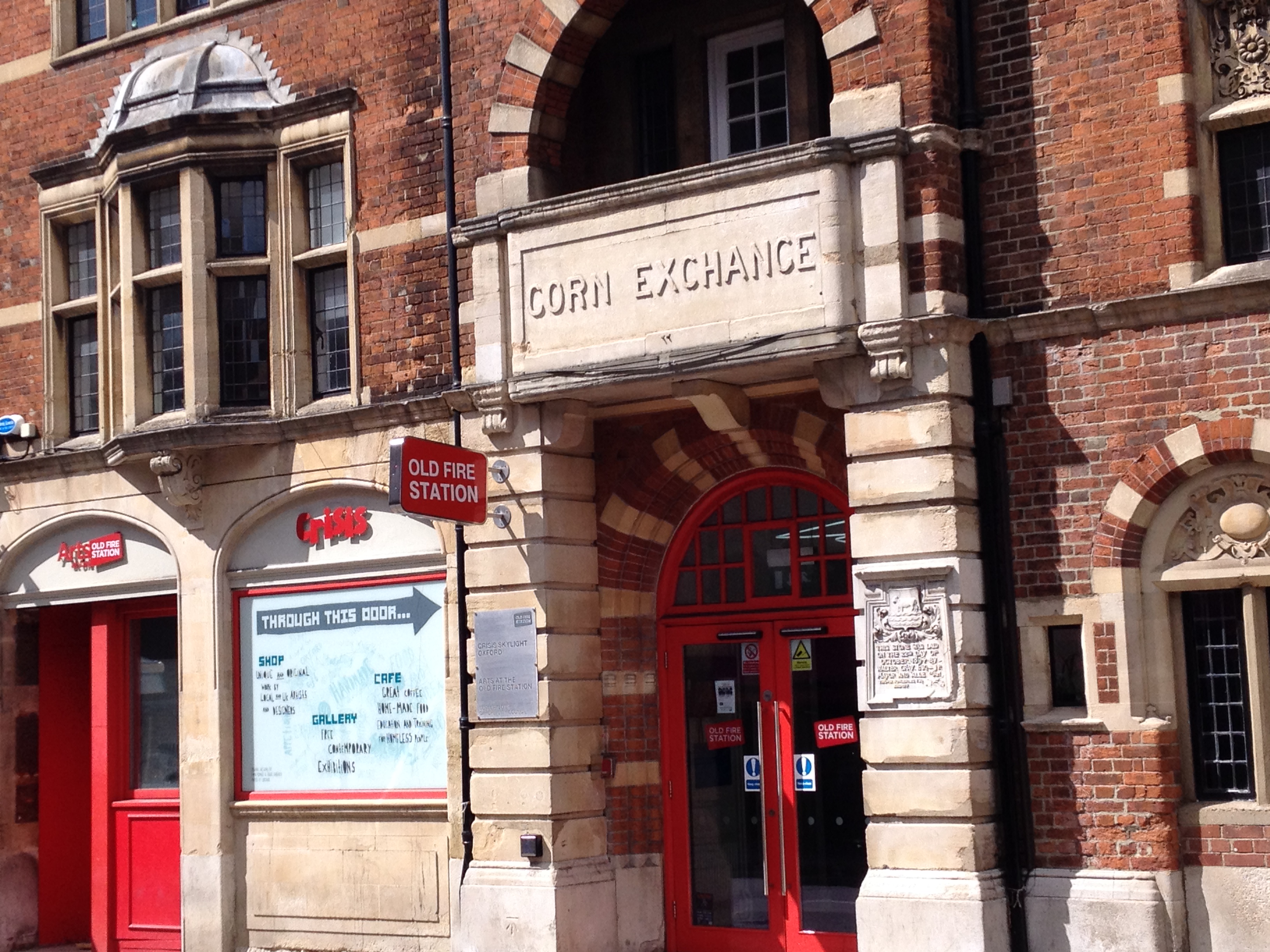
Arts at the Old Fire Station, is an organization that promotes new works by budding performers, writers, and artists and provides space for community dance classes, as well as a gallery and a shop to sell original artwork. There’s a theater for regular performances. That’s where the salsa class is held.

The building is also occupied by Crisis, a charity that aims to help the homeless interact with the community and provides resources and job-training. It runs the Skylight Café which gives on-the-job training for people and provides another place for the homeless to participate in the community.IMG_0615 The café also acts as a gallery to showcase artist’s work. Besides sharing the building with Crisis Skylight, the arts enterprise partners with the homeless organization by providing opportunities for ushers and backstage help. In 2013, writers and performers, including those from the homeless community, collaborated on a piece called “Hidden Spires”. I suppose the Old Fire Station is much like a YMCA, but instead of a swimming pool and karate classes, it focuses on art-based community projects. Arts at the Old Fire Station and Crisis Skylight are dedicated to:

  • Great art for the public
  • Professional development of artists
  • Building the confidence and skills of homeless people

This enterprise is in its infant stages, but it seems to be gaining a solid hold in the area near Gloucester Green. If the attendance for the Zumba class and the Salsa class are any indication of support from the community, then Arts at the Old Fire Station will meet its mission statement.

How does this relate to the Oxford community? It was a varied group of people attending the salsa class. When asked about themselves, they seemed a bit surprised at my questions. One young man, ‘H’, stated, “I’m from Oxford.” Each time I asked, he gave me the same answer. His friend, ‘M’, said he had just joined the working professional class of Oxford. A woman came from a suburb of Oxford, because she liked the drop-in aspect of the class. The ages of the participants ranged from 20 to 65. But the language of dance united everyone. I suppose that is what brings students, immigrants, locals and even tourists together – the urge to learn something new or see what it’s about. And for people who might feel a bit isolated in their regular lives, salsa provides that human contact in an arm around the waist, holding hands, a chance to look into someone’s eyes. You learn someone’s name. The morning after my first lesson, I rode my bike up to Wolvercote Cemetery. In the middle of a busy road, on the pedestrian island, I bumped into a woman I had met the night before in the salsa class. Arts in the community makes a difference.

I plan on dropping in on another class. Even though I may never learn to swing my hips, locking eyes with my partner after a twirl…well, let’s say, it’s worth another lesson.
Spring in Two Scenes

The great thing about the rain here is that when it stops, the sun SHINES! Nothing says Spring like a stroll along the Thames on a bright morning in May. Two of my favorite places near the river, Port Meadow and the Christ Church Meadow, are areas open to the public. They both provide those tell-tale signs of the end of winter – baby ducks, yellow and blue flowers, punters on the river, and the promise of a warm touch of the sun when the crisp breeze stills for a moment. But the one thing that can make or break the experience is an animal associated with the peaceful English landscape. I’m talking about those daft, lumbering cows we see when we are nostalgic and dreaming about the “simple” life. It turns out that I am a bit afraid of cows.

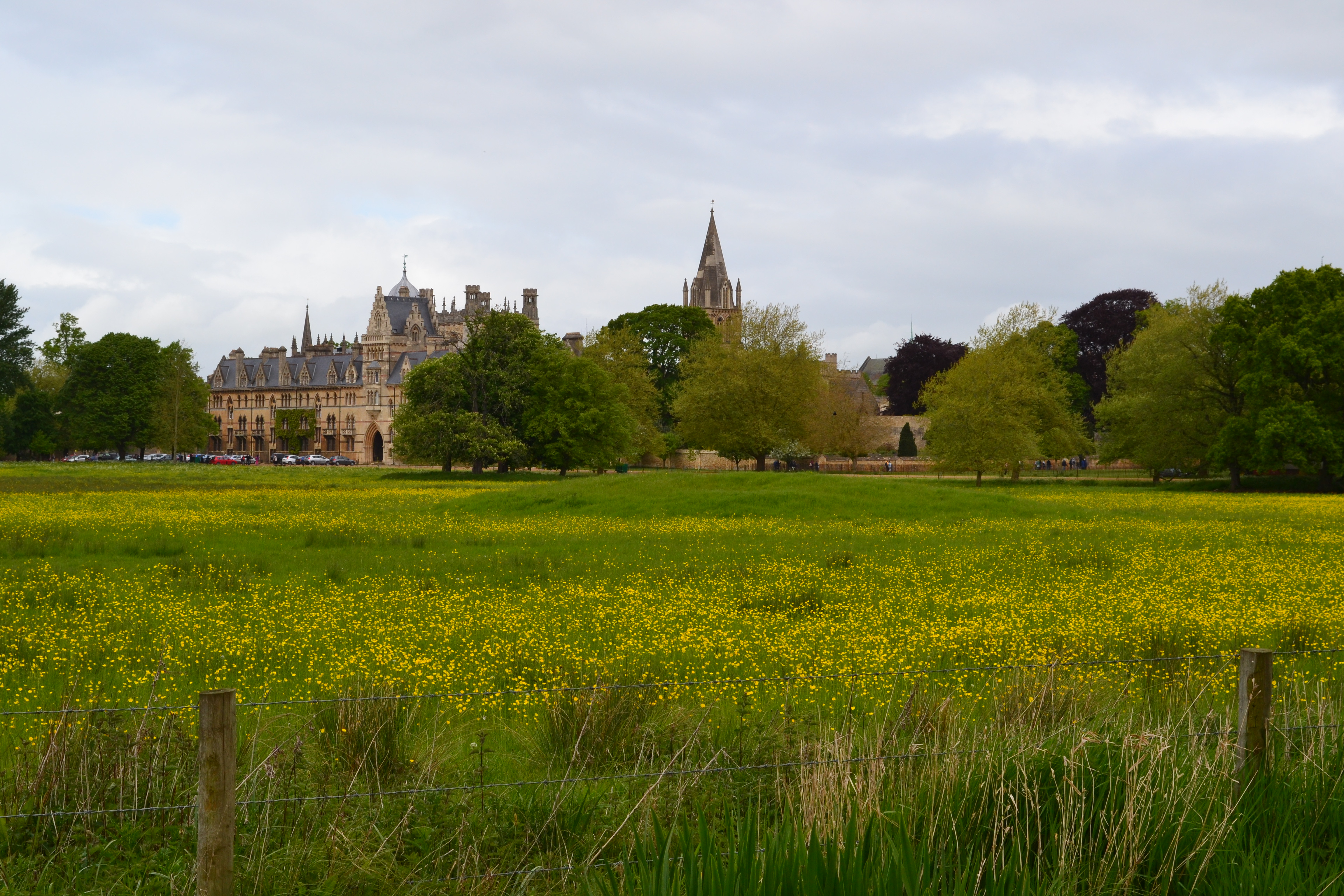
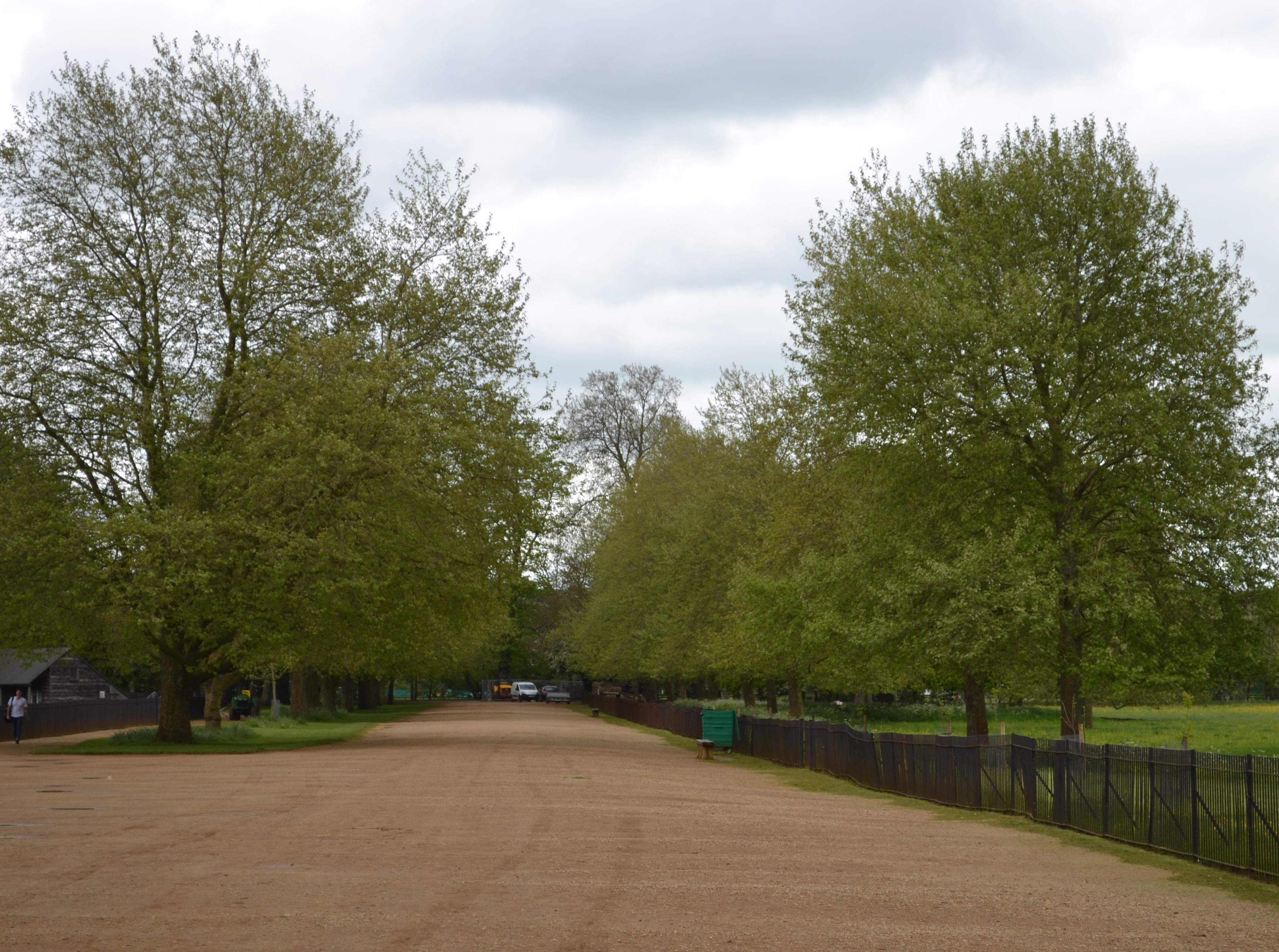
Christ Church Meadow is bounded by the River Thames (also known here as the Isis) and the River Cherwell. From the entrance off St. Aldates, a wide path takes a visitor past the Meadow Building and Merton College to the north and the meadow to the south.DSC_0333 (2) It is difficult to appreciate the meadow without following the wider path for a ways until it forks with one branch leading to Rose Lane via the Botanic Gardens and the other following the Cherwell until it meets the Thames.DSC_0345 The narrow, serpentine flow of the Cherwell accommodates those wishing to meander along its waters in paddleboats and punts.IMG_0570


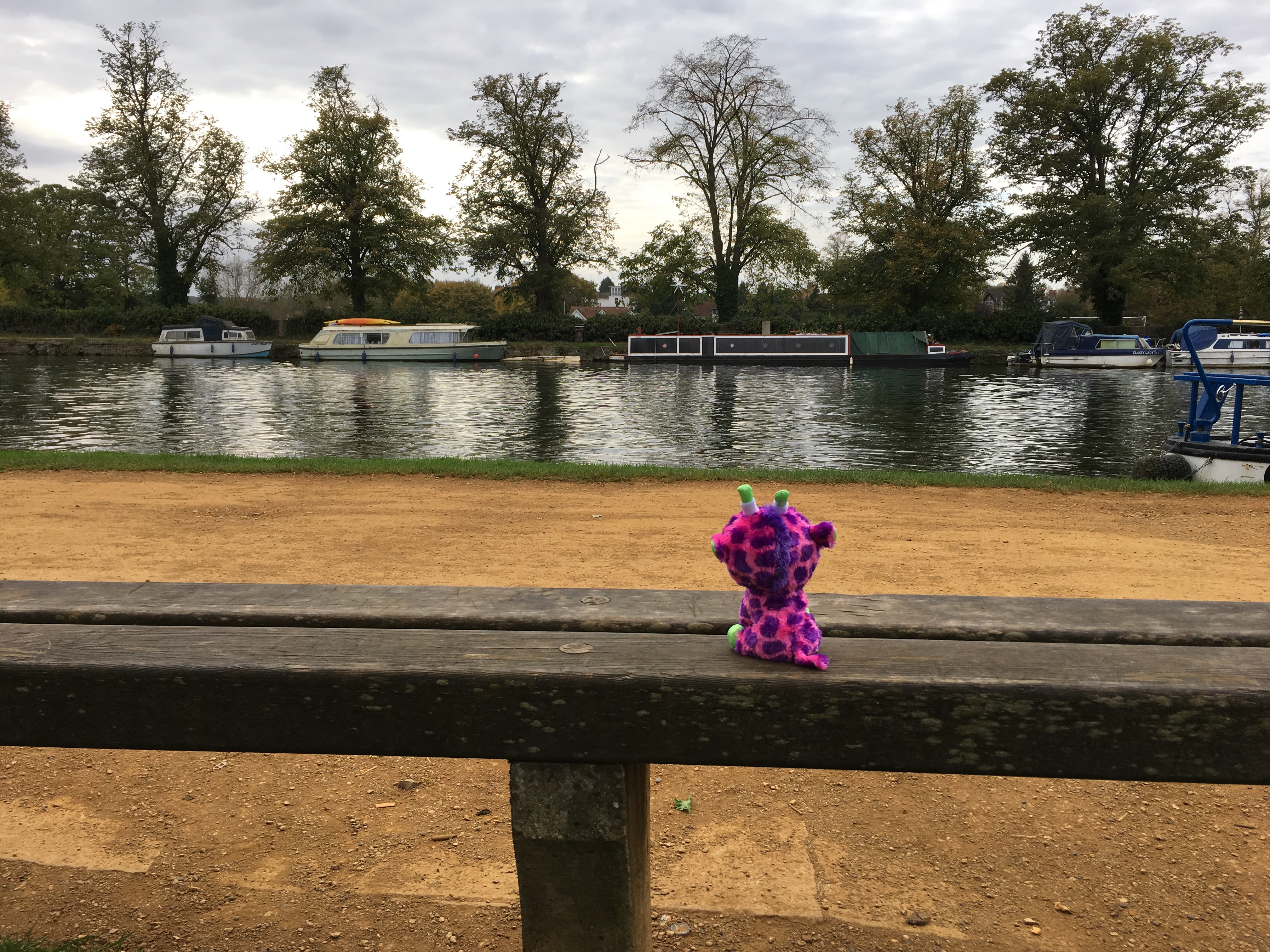
The rowers take to the Thames where they glide around tour boats, punts, houseboats, and the odd kayaker.

IMG_0573


There is a tree-lined path where glimpses of the meadow appear between trees. It is through these windows that the full expanse of the meadow can be seen. The easy walk along the river hides the distance covered over the shady path, so when the path begins to turn to meet up with the Thames, the expanse of the meadow, at least for me, is a surprise when Christ Church Cathedral and Merton College are viewed from that point.

DSC_0351


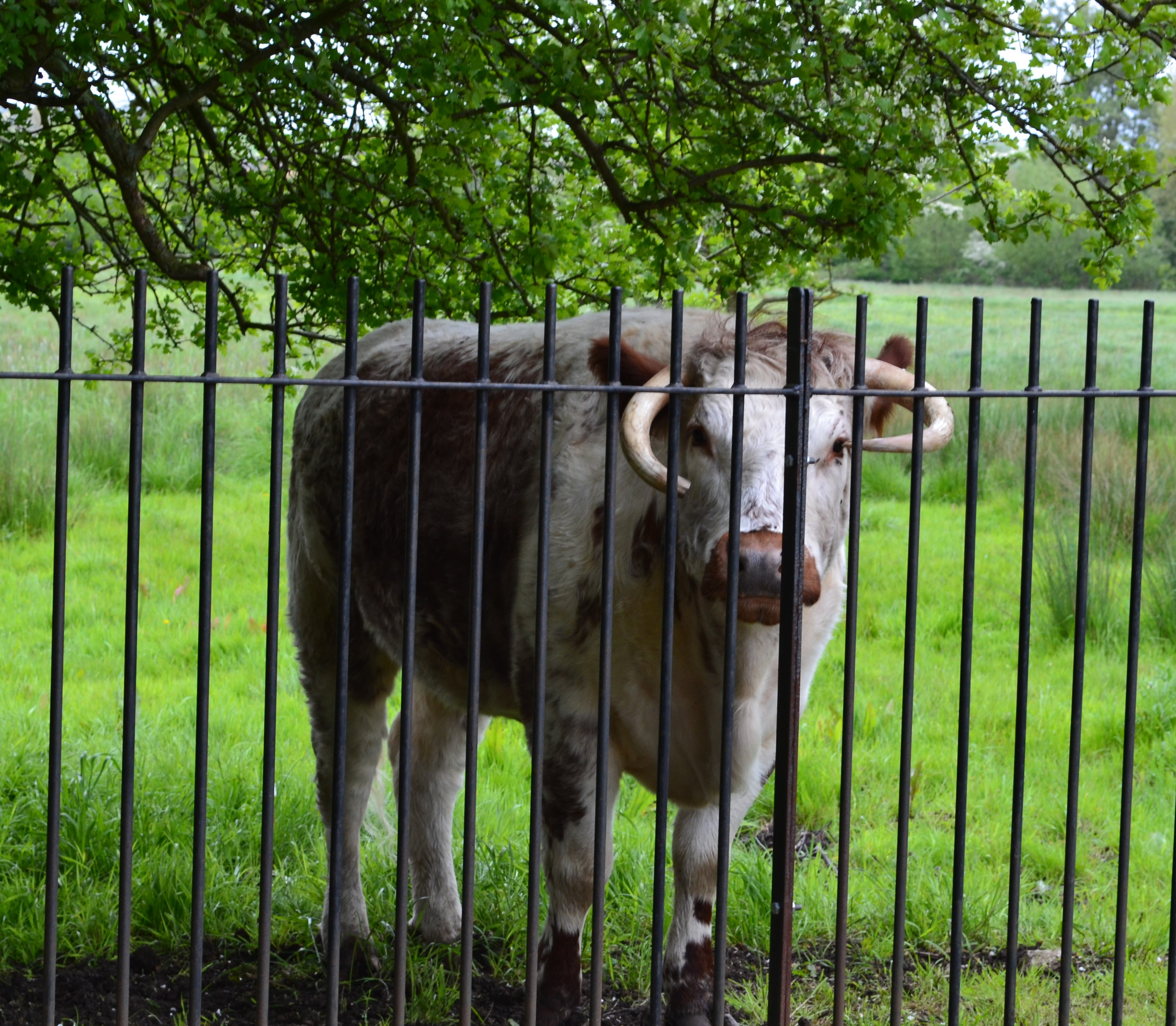
The meadow is fenced, and within the barrier, long horned cattle graze near the New Walk, the wooded path leading from the Meadows Building to the Thames near Folly Bridge and the place in the river where the rowers turn their boats around. The best feature of Christ Church Meadow is that fence. The herd is contained. They munch the green grasses near the walkway, doing what cows are supposed to do. A cow’s purpose is to add to the ambiance of the pastoral scene. The passersby may stop and view the scene, but there is no requirement or expectation to interact with the beasts.DSC_0366 (2)

This is not the case in Port Meadow, because sometime in the 10th century, Alfred the Great rewarded the Freemen of Oxford with free grazing rights on this land and then someone wrote it down in 1086 in the Domesday Book. The Domesday Book holds the results of the land survey undertaken by William the Conqueror. To be fair, this arrangement is responsible for the preservation of Port Meadow. There are artifacts and medieval peoples buried in the soggy earth of Port Meadow where no excavation or development has disturbed them, because it has not been plowed since Alfred bequeathed the land to the Freemen.

Much of Port Meadow is a flood plain. In a cold winter, the water freezes solid enough for ice skating. Someone told me that he didn’t worry too much about breaking through the ice, because drowning is unlikely with the amount of water on the meadow. I’ve seen photos of people skating on Port Meadow and it looks awesome! But I am here in the spring, a time of intermittent flooding and rain. However, to experience a dry, sunny day on Port Meadow in early May is to experience spring at its finest. I was lucky to find such a day.

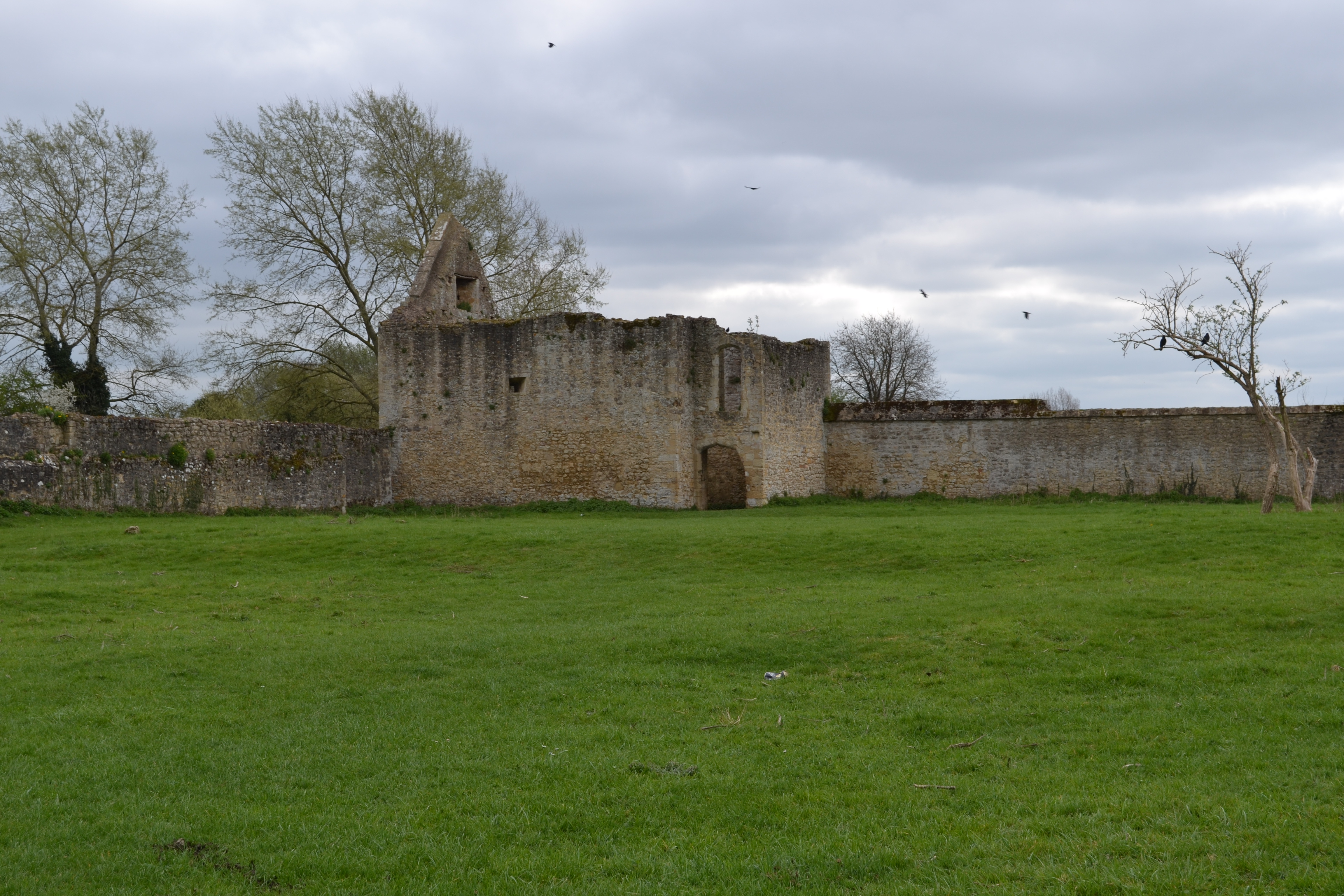
My mid-morning walk began at the entrance near The Trout, a pub on Godstow Rd. On the opposite side of the river, there is a path that winds past the ruins of the Godstow Abbey. Legend and modern accounts tell of May Day mornings when, as the sun rises, spectral singing can be heard from the abbey. Unfortunately, I had to choose between the Hymnus Eucharisticus sung from Magdalen College tower or the abbey on May Day. Since I went to Magdalen Bridge, I cannot attest to the ghostly chorus in Godstow.

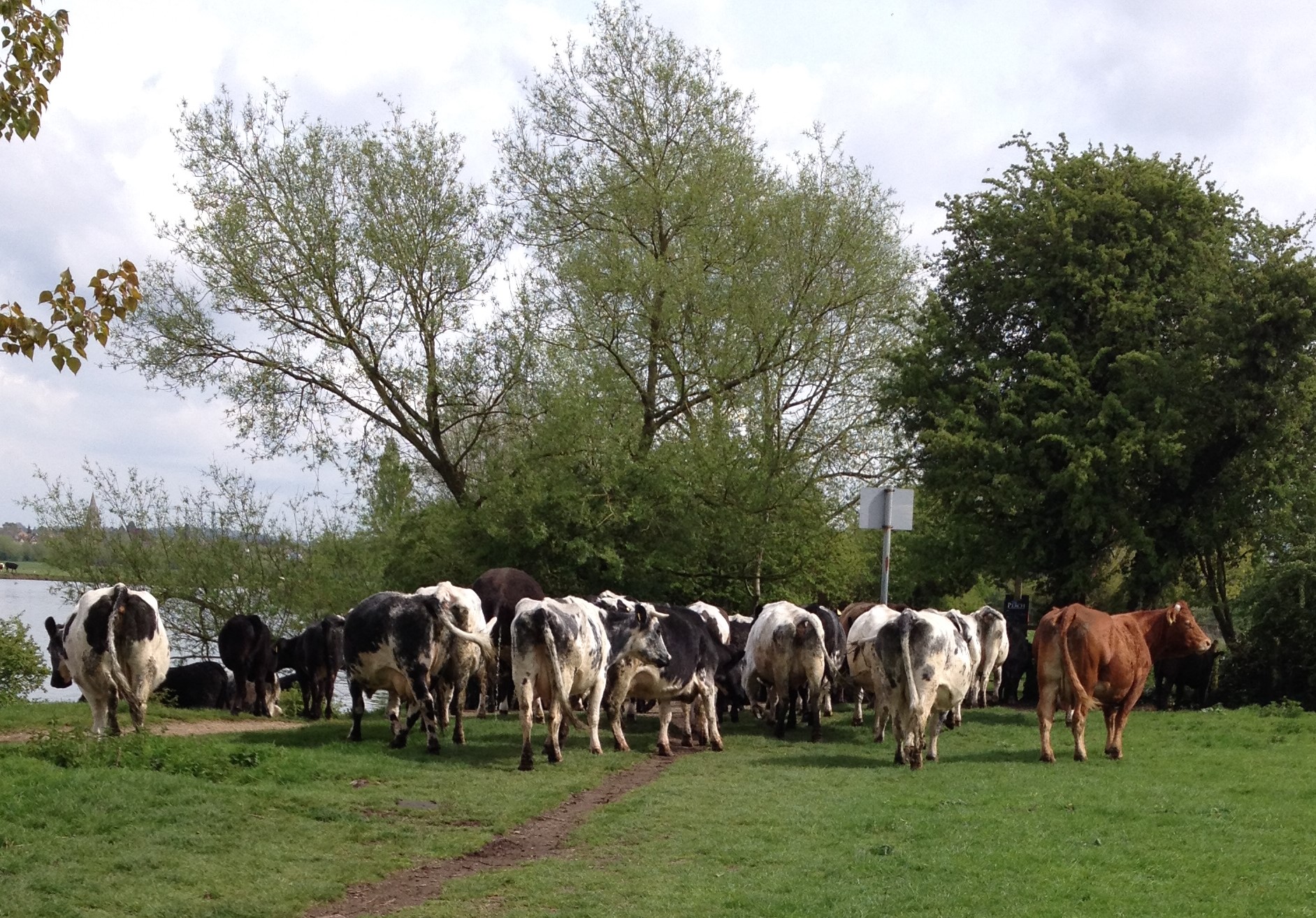
After the abbey, the path leads past the lock into the fields where cows and horses graze. It is most important to remember to shut the gates along the way. This keeps the cows in their rightful place. The walk is pleasant and quite tranquil at times. About half-way from the Trout, there is a path that leads to The Perch, another oldish pub and a welcome place for lunch or a drink. This junction is where I had my encounter with the mad cows.DSC_0192

My walk began, as most do on a life-is-worth-living day like that, with a thoughtful gaze at the abbey. I then admired the goslings and ducklings as they ventured out onto the banks of the Thames. Rowers practiced alongside the tour boats and kayaks.                          IMG_0510IMG_0479 (2)                                                               Rabbit families hopped beside me as I walked. When I stopped they stood frozen on the meadow or scurried their young into the bushes. The grass glowed with white and purple spring flowers. Bees buzzed. Birds sang. You get the picture. On a normal day I would add the picture of cows lolling about in the field, content with their life on the meadow. Those cows have lost their status in this picture of an English countryside.

If you do an internet search with the questions “Are cows dangerous?” or “Do cows kill people?,” the answer likely will include a statistic that tells you that a cow is more dangerous than a shark. The number most often given for cow attack victims is around 100 in the U.S. every year compared to the latest, global number of fatalities from shark attacks. This claim is a bit suspect because it does not take into account the number of human to animal encounters. I imagine if the same number of people that encounter cows encountered sharks, then sharks would beat out cows in the statistics. I must say, though, that I have been in the water somewhere near-ish a Tiger shark and it did not attack me. (See this link for a scary shark photo  http://www.thomaspeschak.com/kayak-great-white-sharks-/  ) I cannot say the same for a certain cow.

The plan was to drop by The Perch for lunch. Just a few yards from the gate, a mother cow, who had been grazing near the river, charged at me as I walked past her and her calf. I retreated, waited a while and tried the long way around her, but she charged again. Other than running, I have no idea how to handle an aggressive cow. Another walker joined me (he knows about cows). While we waited to see if she might leave, the rest of the herd decided to try and escape through the closed gate. They reminded me of a Gary Larson cartoon as they bunched up against the gate to nowhere. IMG_0484 (2)While the others jostled for position, the mother cow took sentry duty and bleated her non-stop warning. My new friend knew enough not to challenge a mother who was much bigger and faster than us. We went back the way we came.

Port Meadow is ruined for me now. What if she is just waiting to jump out at me the next time I enter her turf? What if I now have a cow stalker? One morning I will wake to find her leaning against the lamppost with cigarette butts scattered around her hooves.

Holy Week

There are plenty of options for worship in Oxford, even for an apathetic Christian like me. My religious participation during Holy Week (or any other week) is sporadic at best and more often non-existent. This can become problematic at times, because my mother is the pastor of my hometown’s Presbyterian church. So, due to a vague promise made to my mother and a guilty conscience (along with a tsk-tsk from my mother’s friend) for skipping Ash Wednesday services, I decided to go to church on Easter Sunday. As it happened, my participation in Holy week was three-fold.

The first was Palm Sunday. I could say that I planned to join the procession to the Church of St. Mary the Virgin in Radcliffe Square. However, I must admit that I was there taking pictures and happened upon the parishioners with their palm fronds. Moved by their singing, I joined the procession. When we reached the church’s entrance, I looked upward to a cloudless sky and chose the photo session. This was not a decision made lightly – church vs sun. But this is the UK, where churches are more plentiful than sunshine on an April morning.

My second nod to Holy Week involved a performance on Maundy Thursday featuring the Oxford Philomusica and the Choir of The Queen’s College. The concert, held in the Sheldonian Theatre, featured Bach’s Christ lag in Todesbanden and James MacMillan’s Seven Last Words from the Cross. The Sheldonian Theatre was the first building designed by Christopher Wren, who went on to re-build St. Paul’s Cathedral after The Great Fire of London. The Sheldonian Theatre was designed for University graduations and functions. I am not a music critic and do not claim any knowledge of the complexities of the compositions I heard that night, but I will say that the acoustics of the building are first-rate for a choral concert. Being moved by Bach in the Sheldonian was a given for me. I was surprised, though, by the depth of my response to MacMillan’s work, a modern composition I was determined to dislike. Like I said, I’m no critic, so I won’t make any attempt to describe the music. I will recommend that you find a recording and listen to it in an uninterrupted silent setting. A word to the wise here. If you can afford the chair seating in the Sheldonian, choose it over the gallery seats, unless you are at least six feet tall and have a strong back. The bench seating is uncomfortable and much of it backless. It required a lot of squirming and repositioning for me to actually get my feet to touch the floor. Also, the windows around the ceiling were propped open a bit and the street noise leaked into the gallery. Sitting up front would eliminate some of that noise.

My final and promised destination for Holy Week was Christ Church Cathedral for Easter Sunday services. Christ Church Cathedral began as a chapel for Cardinal College in the sixteenth century, an ambitious endeavor planned by Cardinal Thomas Wolsey, Lord Chancellor to Henry VIII and a man who hoped to become Pope one day. Unfortunately for Wolsey, he failed to make good on his promise to arrange an annulment of King Henry’s marriage to Catherine of Aragon. When Pope Clement refused to grant the annulment, Wolsey lost favor with the king, the Crown seized Wolsey’s vast wealth and estates, and he only escaped his execution by dying shortly after his arrest in 1530. Henry renamed the college to King Henry VIII’s College and then after naming Oxford a diocese, the king made the chapel a cathedral. The church is not cathedral-sized or even particularly grand, but its diminutive stature suited the Easter Sunday service.

Unlike large cathedrals open to the public, the secluded nature of the church within Christ College made it possible to worship without tourists and cameras. I remember visiting Notre Dame Cathedral in Paris on an Easter Sunday morning. We went down to listen to the bells and be a part of the celebration. But we did not go into the church while the service was conducted. Even though it was open to tourists, it seemed too intrusive to wander around the worshipers. At Christ Church, a porter stood guard to weed out the worshipers from the curious, while still welcoming strangers into the church. The churchgoers represented countries, ethnicities, religions, and communities. I felt comfortable, even though I had no family or friends with me on a day that is traditionally spent with loved ones. It was the perfect place for me to celebrate Easter.

I don’t know why I am so reluctant to discard religion completely. My intellect overpowers my creative and spiritual tendencies when it comes to believing in God. I dislike the rules and regulations of organized religions that attempt to dictate an individual’s experience with God. Maybe my hesitation has to do with the hypnotic effect of the pageantry involved in cathedrals or the harmonious voices offering praises from the choir. Yet, because that mesmerizing pull is dangerous, I approach those feelings with caution as I remember how pageantry and words can lead the masses to tyranny, rather than spiritual awakening. Maybe I want to participate in that shared experience of being one within a group or knowing that even though I am a small part in this world, that when I join with other small parts, we make up the whole of the Universe. Perhaps, I’m just not ready to give up on God.

It’s Never Too Late — Just Different Part II

As I mentioned in an earlier post, I always wanted to study in Oxford. It never worked out and it will never happen — at least not in the way I dreamed the dream. It would require a time machine, the Fountain of Youth, and possibly a more classical education. What’s this? Never say never, you say? I speak the truth here. While it is possible to go back to college in midlife (I did it), the experience is different. I remember practicing conversation in my French classes as an older student. How could I relate to the scenarios of dorm life, clubbing, and entertaining my parents on campus?

I am neither don nor student. The quads of the colleges are hidden behind walls and gates and “no unauthorized entry” signs. The only way I can see them is with a tour guide or during visiting hours with an entrance ticket. I should walk the streets, dejected and powerless, lamenting my lost dream. But here’s the thing: It Doesn’t Matter. I’m creating my own experience.

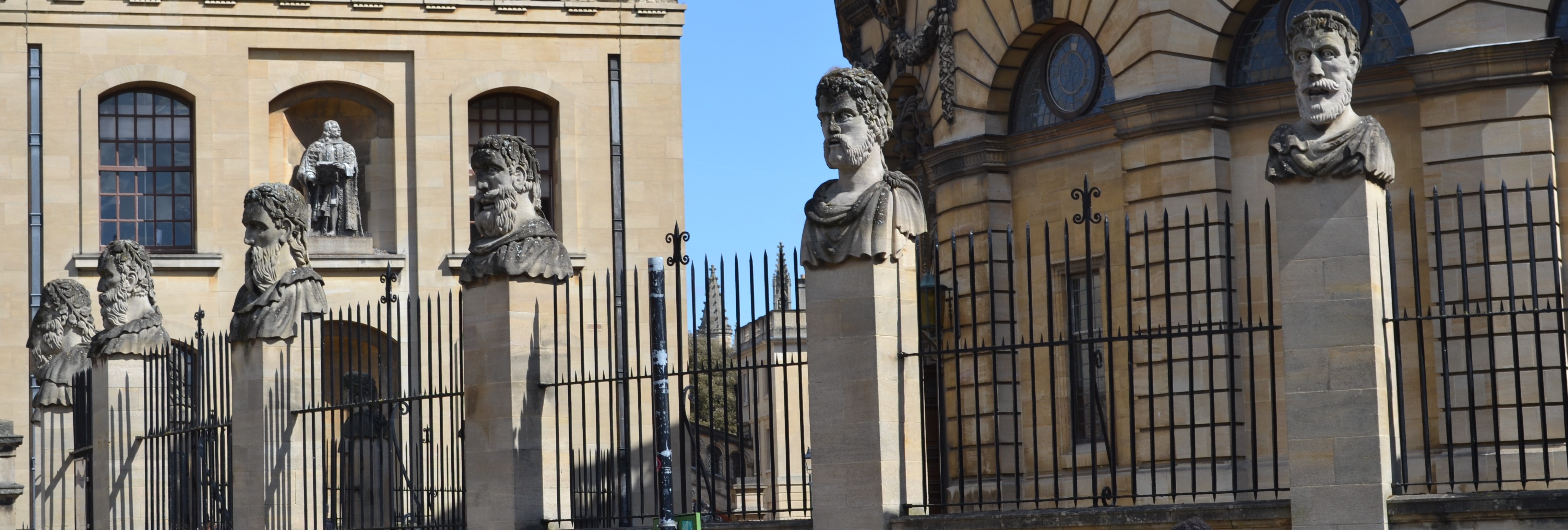
Every day I have the opportunity to bike or walk into central Oxford. I lock my bike onto a bike rack in front of the Lamb & Flag, a pub whose origin and ties to St. John’s College began in the early 17th century. JRR Tolkein, CS Lewis, and Graham Greene frequented the tavern and it is said that Thomas Hardy worked on Jude the Obscure in the Lamb & Flag. I can walk past the “Bearded Ones” and the Sheldonian Theatre (designed by Christopher Wren) DSC_0271 (2)or visit the Old School’s Quadrangle of the Bodleian Library with its doors marking the schools of the university.DSC_0221 (2) On April 23rd I can stand in front of Carfax Tower and hear the bells peal for St. George, the dragon-slayer and Patron Saint of the Most Noble Order of the Garter. DSC_0276 (2)I walk along Queen’s Lane where all sound from the busy High Street is silenced. And most days I make sure I go to Radcliffe Square and hang out around the circular building known as Radcliffe Camera.

Just last week, I went into Blackwell’s Bookshop (http://www.britainexpress.com/cities/oxford/blackwells.htm) and met Sir Roger Bannister, the first man to run the mile in less than four minutes. He accomplished that feat here in Oxford in 1954. Yesterday I turned down an unfamiliar road and stumbled across the Story Museum (http://www.storymuseum.org.uk/) and a reading of Treasure Island with Philip Pullman, author of The Golden Compass.

I cannot feel sorry for myself, because my education does continue. Every experience I have here stirs curiosity. Walking and riding my bike strengthen my body. Who needs a gym? For the first time in many years, I sleep uninterrupted. DSC_0171Here, in my own little room, I write with a zeal I thought was lost. Maybe not studying here was the best thing that ever happened to me.


It’s Never Too Late – Just Different! Part 1

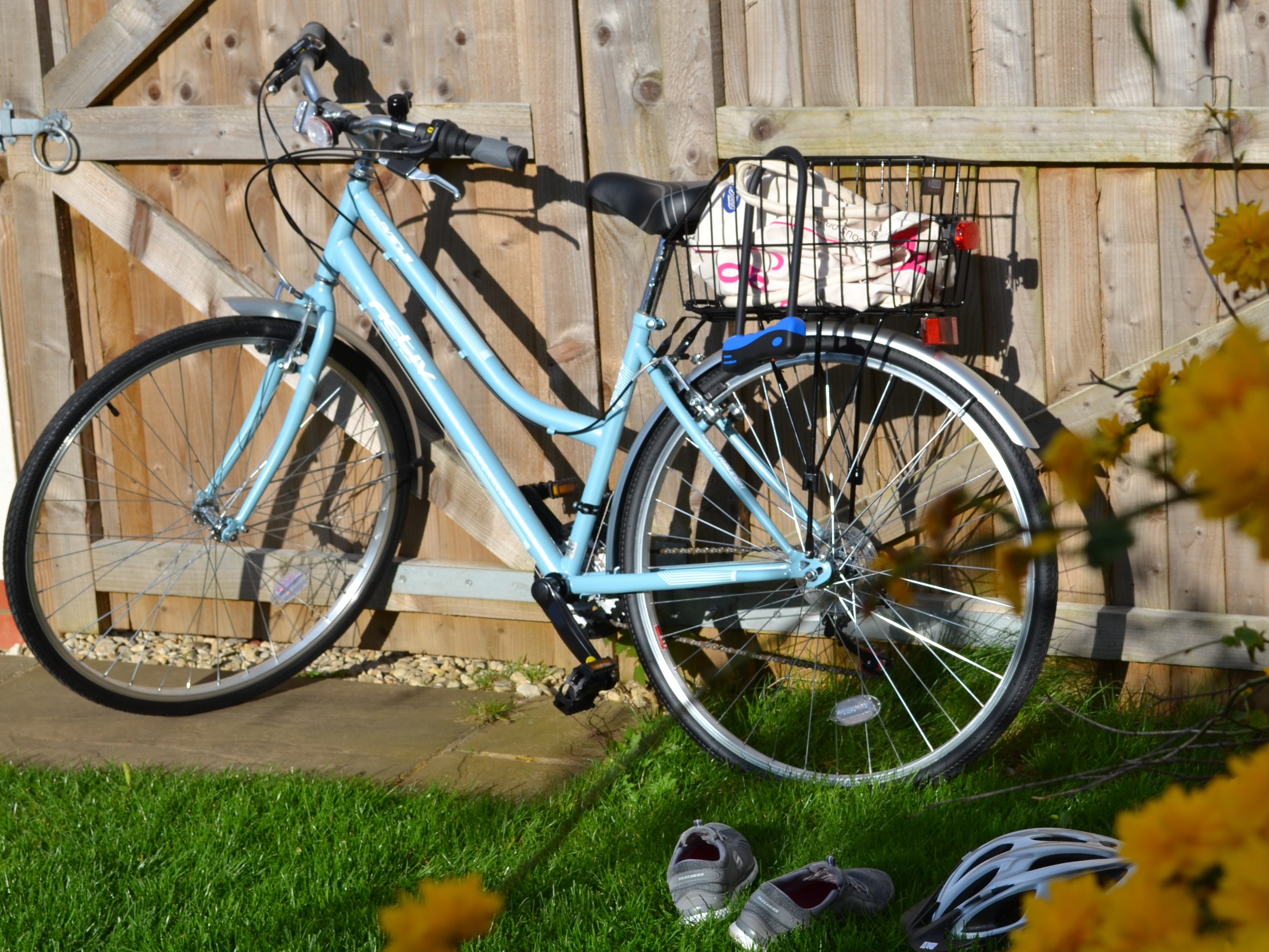
This morning I executed my first right-hand turn off of Banbury Road. Taking my brand-new, Robin Blue trekking bike out of the bike lane required confidence in my ability to translate American left-turn into English right-turn. I’m pretty sure I had twenty opportunities to make the turn before I felt sure enough to leap ahead onto the side street. That turn is one of the many “firsts” I am adding to my list. But let’s get back to the bike.DSC_0202 (2)

My bike is an Activ Fifth Avenue, a combination between a cruiser and a mountain bike. I thought it had six gears, but it has eighteen (note to self : pay attention to the bike guy as he lists the specifications). This bike is weighed down by every item necessary for a cruising bike. Its fenders shine in the daily minute of sunshine. The bike’s bell dings to warn pedestrians of my unsteady approach and it has an array of flashing lights that glow like something from Area 51.  Best of all — it has a basket on the back for carrying a picnic lunch to a spot by the river or canal. Anyone who has ever bought the bike of his/her dreams knows why I love mine.

It is possible to become childlike on a new bike. I’m not talking about reverting back to childhood or my early twenties or even my early forties. That is impossible. What I am talking about is riding a bike for the pure pleasure of pretending I am whatever I want to be when I grow up.  For some people, a bike is a means of transportation. For others it represents training and discipline and a faint hope of riding with elite bikers in the Tour de France. For me, a bike opens up possibilities.  I ride my bike through the unfamiliar neighborhood with an unguarded view of the world. I get to smile at people and nod a hello or mutter “sorry” when I veer too close. If I take enough antihistamine, I can stop and smell the roses or drop my bike in the grass, so I can lie on my back and watch the clouds move through the sky. Riding my bike reminds me that it is never too late to dream.

I know this because I am now living my childhood dream.

Cosmopolitan I am NOT!

Standing at the bottom of the stairs in the Green Park Underground exit made my current situation absolutely clear. There was no way I was going to pull my bag up those stairs. My daughter’s advice on which stop to take for my Piccadilly hotel was spot on. Too bad I hadn’t listened to her.

It took me two weeks to pack for my trip. My possessions are scattered from Utah to Idaho to California. The only reason I didn’t leave something (like my car, for instance) in Oregon was that I went to California first and needed only a carry-on for my visit to Portland. Two hours before I drove to SFO for my Heathrow flight, I continued to waiver on the bags I would take for my six months in Europe. It occurred to me, as the commuters rushed past, that my final decision was a miserable failure. And possibly not just the suitcase. Maybe my whole trip was a mistake.

But then he appeared –- my suitcase savior, a good-natured man in a tuxedo who asked if I had my husband in the bag. He carried it up the stairs, dropped it, exclaimed to his friends about the weight, and disappeared into the crowd. So… damsel in distress meeting her knight in shining armor? Probably not.

At least the hotel was downhill and just a few blocks from the Underground. I mean literally down the street. All I had to do was walk until I ran into it. The problem, of course, was that to get in through the front entrance, I would have to climb more stairs, manage a revolving door, and drag my suitcase through the lobby/café/bar and up more stairs to the concierge. So I remembered the back way to the hotel reception and proceeded to do what I do best – get lost. I carried several maps, a mobile phone App with a map, and a GPS device. All of them nestled comfortably in my bag.

Whoever tagged the British as cold and reserved did not experience their kindness like I did that evening. These people see dumb tourists every day and must deal with stupidity often. Yet those men came out of their buildings, jumped out of their cars, and tried to direct me the best they could. Each time I got it wrong, someone was there to help me. Finally, the last person walked me to the door.
If I learn nothing else from this trip, I hope to remember that I’m never alone in this world.

Except, maybe all the nights I must face the humiliating, pathetic ritual of eating alone in a restaurant. We’ll talk about that one later.

Missing the Bus

There are plenty of times in my life when I have literally missed the bus, running with legs flopping in all directions or on my toes with my feet turned out as if I were a ballerina leaving the stage. Certainly, we all have “missed the bus” when it comes to repairing relationships or grabbing on to an opportunity. But what happens when missing the bus becomes the impetus to change and grow or to just DO IT! Whatever IT is. In a couple of weeks, I’ll be on my way to Oxford, because one year ago, almost to the day, I missed the bus back to London from Oxford.

Before that fateful day, my impressions of Oxford were built on books, Inspector Morris and Inspector Lewis, and travel and history shows. My dream was to study History in Oxford. That dream never materialized, yet the possibility of Oxford followed me as a certainty. Last March as I walked alone in Oxford for the day, the realization hit me. All the reasons for putting aside my dream had skedaddled (to put it mildly) and it seemed that there are times in one’s life when doing the impractical becomes the practical thing to do. Standing on High Street in the rain, I concluded two things.

First, I am in a unique position where I can chase my dreams without hurting anyone in my life. My running off to England jeopardizes no other person’s happiness. Yes, I’ll miss my family and yes, they will worry about me. But my running away shows them that adversity is overcome – that we are in charge of our own happiness. Kate Morton in “The Forgotten Garden” reflected on this when one of her characters stated,  “You make a life out of what you have, not what you’re missing.”

And let’s face it. My children can use a break from “Momwatch”.

The recent deluge of books and articles on finding happiness is reflective of the wanting of our souls for something meaningful in our lives. We throw away old things because new things make us happy. We chase the dream of success only to find that each rung up the ladder takes us further away from the ground we call our soul. More money, the perfect spouse, the best clothes, and the approval of others offer new chances for happiness. Okay, I hear the chorus behind me and I feel the pointing fingers. I suppose that is exactly what I am doing. I’m looking for happiness. My mother said what everyone in my life is thinking. “I hope you aren’t expecting a radical change in your life with this trip.”

The radical change happened already. I just figure that even though loneliness might follow me to England, at least I will be lonely in a different place.

The second realization that hit me as the rain cleansed my soul there on the Oxford High Street?

An umbrella wouldn’t come amiss.