

This morning, awaking with a desire for immediate gratification, I decided to take my laundry to the launderette around the corner and pay to have dry clothes within a couple of hours rather than a couple of days. Later, because I dropped off the clothes with only a vague idea of how much this luxury would cost in Great Britain Pounds and then US dollars, I visited the laundry’s website and learned its hours might be affected by St. Andrew’s Day, a bank holiday celebrated on November 30. Researching St. Andrew’s Day led me to the Stone of Destiny.
First, the two-minute lesson on St. Andrew’s Day: Andrew was the brother of Peter and was one of the disciples present at the Last Supper. He continued to preach Christianity until he was crucified by the Romans on an X-shaped cross in Patras, Achaea. St. Andrew was known for his generosity, something Scotland takes seriously. I have seen this characteristic in most of the people I encounter here with their willingness to help and their friendly interactions. Even the curmudgeons smile as they deliver a grumpy dialogue. On November 30, Scotland celebrates an extra kindness day in honor of St. Andrew and fills it with ‘all that is good about Scotland’.
Andrew was named the patron saint of Scotland in 1322 after the signing of the Declaration of Arbroath proclaiming Scotland’s independence. There are various accounts of how Scotland acquired a few of St. Andrew’s relics. One of them involves a Greek monk named Regulus and a shipwreck in Fife. The bones included an arm bone, a tooth, a kneecap, and a couple of fingers. They were stored in the cathedral in modern day St. Andrews until around 1560. Two relics survived the Protestant Reformation and are now in Edinburgh under the care of St. Mary’s Roman Catholic Cathedral.
According to Scotland.org, the celebration of St. Andrew’s Day began in the United States by a group of 18th century Scottish ex-pats in Charleston, North Carolina. The Saltire, the Scottish National Flag, holds the symbol of St. Andrew’s Cross and must be flown on all Scottish Government buildings with a flagpole on November 30, even if it involves replacing the Union flag with the Saltire. November 30 was declared a Bank Holiday in 2006, although it is not mandatory for banks to close. My nearest branch of the Royal Bank of Scotland had its doors wide open today.
What does this have to do with the Stone of Destiny? If you remember (I didn’t either), the Stone of Destiny (or Stone of Scone) was used as a coronation stone for Scottish kings until Edward I took it from a monastery in Perth to Westminster, where it became part of St. Edward’s Chair, the chair used at the coronation of English sovereigns who proved their truth by submitting to the stone’s judgement. The chair was used for the coronation of Queen Elizabeth in 1953, but not before it made a frenzied journey to Scotland and back.
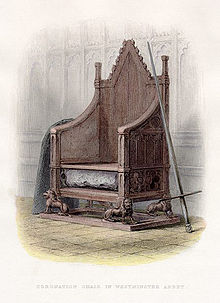
On Christmas Day in 1950, four Scottish Nationalists, university students from Glasgow, stole the stone from Westminster Abbey, breaking it in two during the process. They hid the largest part in Kent and waited a few days before unearthing it and taking both pieces back to Scotland. Ian Hamilton, one of the students involved in the caper, was asked why he wanted to bring the stone back to Scotland. “I wanted to waken the Scots up, that was all.” (See http://www.telegraph.co.uk/culture/film/3743946/Ian-Hamilton-on-Stone-of-Destiny-I-felt-I-was-holding-Scotlands-soul.html for more of this story).
The students deposited the stone at Arbroath in plain sight until the police found it. After spending a night in a prison cell for security reasons, the stone was returned to Westminster where it remained until 1996 when it was loaned to Scotland. It was returned on St. Andrew’s Day in 1996, witnessed by ten thousand people lined up along the Royal Mile. It now resides on display at the Edinburgh Castle with the agreement that it will be returned to Westminster for future coronations. The students were charged with the crime, but were never prosecuted.

Edinburgh Castle must provide free entry on St. Andrew’s Day, giving everyone the opportunity to view the stone. I have seen the stone on a previous visit, so going to Edinburgh Castle on a holiday with free entry was not on my agenda. I did read (and I did not gain visual proof) that the castle, because it is a British garrison, must fly the Union flag on all days. This has created a controversy for years and resulted in numerous petitions and calls for the Saltire to fly on the castle instead of the Union Jack. I read, and again I’m not sure I’ll walk to the castle tonight to verify this, that St. Andrew’s Cross will be projected onto the side of the castle — just in case you thought the issue of Scotland’s independence from the United Kingdom was settled in 2014.
Ownership of the stone is not the only controversy. There is growing speculation and perhaps some evidence that the stone grabbed by Edward was a copy and the original stone never left Scotland.
Disclaimer: This is not intended to serve as a well-researched or complete history. There are tons of informative websites, books, and movies with a more detailed history of both St. Andrew, the Stone of Sconce, and the Westminster Abbey crime.
 Kathy Travels Europe